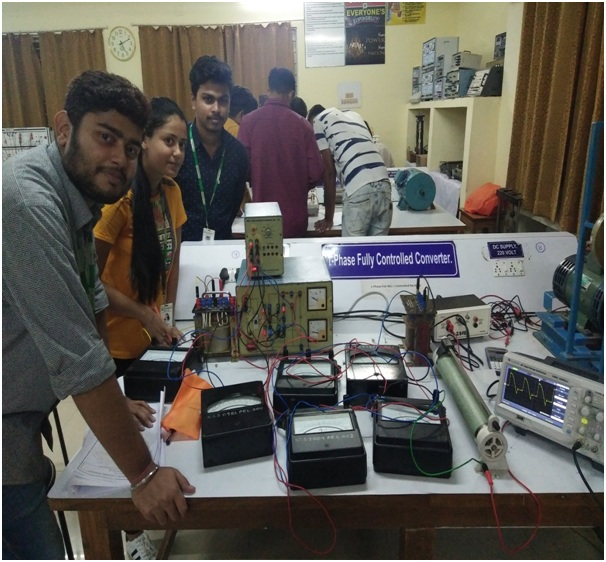

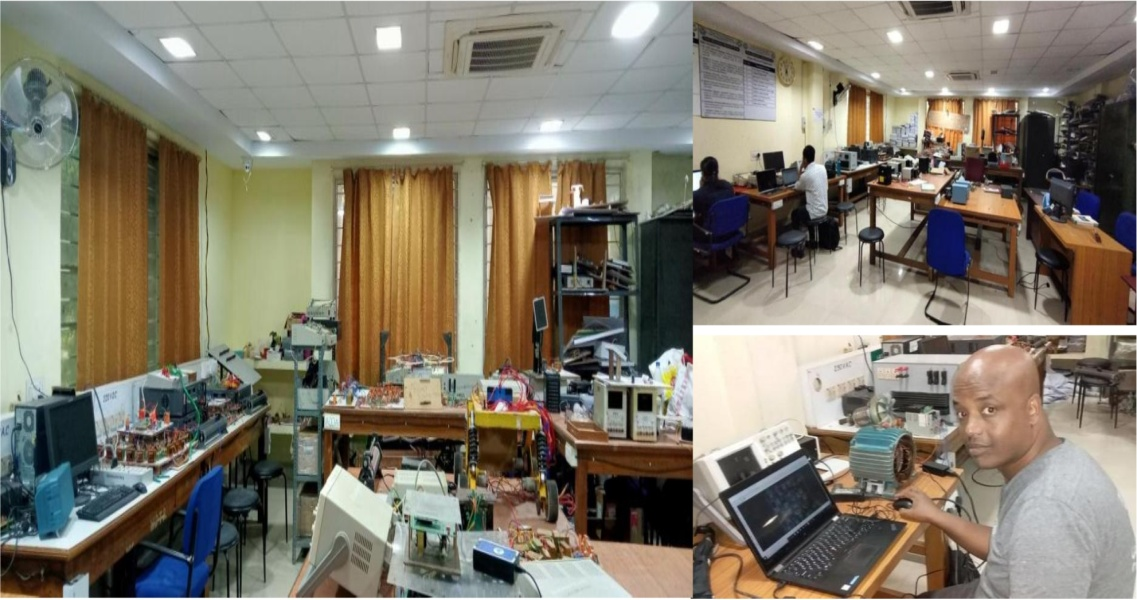
Power electronics laboratory
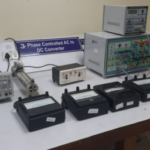
The power electronics lab houses advanced converters and a variety of power semiconductor devices such as diodes, thyristors, MOSFETs, and IGBTs. Equipped with oscilloscopes, digital controllers, and simulation software, it supports comprehensive analysis and experimentation in power electronics. The lab serves as a practical platform for students and researchers to explore applications like renewable energy systems and electric vehicles. Its primary focus is on designing and optimizing converters to improve efficiency, reliability, and overall performance in power electronic devices and systems.
In power electronics lab, students gain hands-on experience in understanding and implementing diverse converter topologies including DC-DC converters for efficient voltage regulation, DC-AC inverters for converting DC power to AC, AC-DC rectifiers for converting AC to DC, and bidirectional converters for versatile energy flow management. Additionally, students study the intricacies of power semiconductor devices such as MOSFETs, IGBTs, thyristors (SCRs), diodes, and cutting-edge technologies like SiC (Silicon Carbide) and GaN (Gallium Nitride), learning about their operational characteristics and applications in power electronic circuits.
- Objectives:
The objective of the B.Tech power electronics lab is to provide students with hands-on experience and practical understanding of power electronic devices, circuits, and systems. Through experiments and projects, students learn to implement various converter topologies such as DC-DC converters, DC-AC inverters, and AC-DC rectifiers. They study power semiconductor devices like MOSFETs, IGBTs, and thyristors, exploring their characteristics and applications.
Detailed Description of major equipment and instruments:
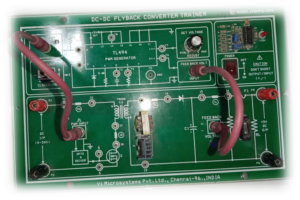
| DC-DC Flyback Converter
|
The fly-back converter is employed in regulated DC supplies. One such application is the SMPS of the Desktop computer. The waveforms of the closed loop and open loop systems are studied and traced with the help of the CRO. |
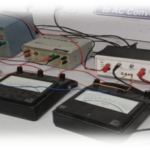
| Single Phase AC to AC voltage regulator
|
The single phase voltage controller is used to regulate the output ac voltage.The triggering angle is varied to vary the output rms voltage and the corresponding output voltage waveforms are traced from the CRO. |
| The H-Bridge PWM single-phase inverter.
|
Students learn to control harmonic content, frequency, RMS value, and modulation indices using PWM techniques that involve intersecting sinusoidal and triangular waves. |
| VI Characteristics of the SCR.
|
Study the behaviour of the Silicon Controlled Rectifier (SCR) using an experimental setup, which aids them in analyzing the response of the semiconductor’s P and N layers in both forward blocking and forward conduction modes. |
 |
Available Software:
· MATLAB/SIMULINK · Multisim · NI-LabVIEW |
 |
TEKTRONIX A622: Current Probe, AC/DC, BNC Plug, Current Clamp, 100 A, 50 mA
TA044: Oscilloscope Probe, High-Voltage Differential Probe, 70 MHz, 7 kV, 100:1, 1000:1
|
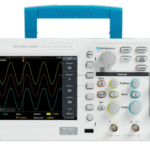 |
TEKTRONIX TBS1052C
Digital Oscilloscope, TBS1052C, 2 Channel, 50 MHz |
B.Tech.capstone Projects in PE Lab:
- Design and Implementation of a high-efficiency DC-DC converter for renewable energy systems and electric vehicle charging
- Grid-Tied Inverter for Solar Photovoltaic Systems
- Developing a BMS for managing lithium-ion batteries used in electric vehicles or energy storage systems
- Investigating and optimizing the performance of resonant power converters (e.g., LLC resonant converters, ZVS converters) for high-efficiency power conversion.
- Developing motor drive systems using variable frequency drives (VFDs) or servo drives for industrial applications, robotics, or electric vehicles
- Collaborated with SMPS, BBSR for designing and fabricating fast EV charger.
Lab photos